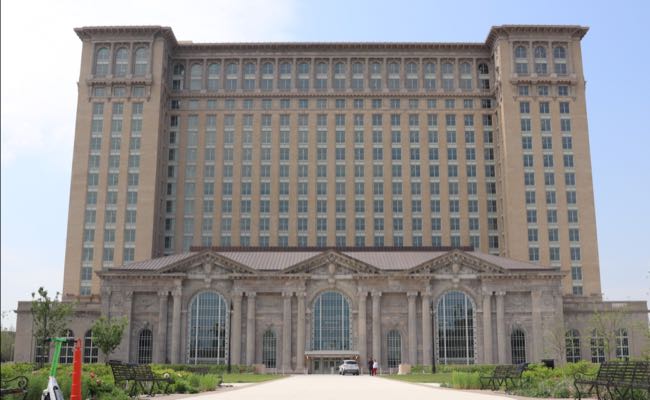
The last passenger train pulled out of Michigan Central Station on January 5, 1988, headed for Chicago. Thirty-six years and five months later, the doors opened again. Ford Motor Company spent six years and roughly $950 million on the restoration of the Beaux-Arts depot and its surrounding 30-acre Corktown campus.
The station itself accounted for about $740 million of that. The reopening came with a ten-day public event called Michigan Central OPEN, running June 6 through 16. Tickets to the kickoff concert in Roosevelt Park sold out in five minutes.
Inside, visitors got their first look at the restored Grand Hall, ticket lobby, and concourse since most of them had been alive. Bill Ford, the company's executive chair, bought the building from the Moroun family for $90 million in 2018. He had grown up watching the station decay across the river from Dearborn.
The original limestone for the exterior came from a quarry in Indiana that had since closed. Ford persuaded the owners to reopen it. The Grand Hall ceiling required the equivalent of 8.7 miles of grout to set 29,000 Guastavino tiles.
About 1,300 of those tiles are new. The other 27,700 are original. The station was designed by Warren and Wetmore and Reed and Stem, the same firms that designed Grand Central in New York.
They worked on both projects at the same time. When Michigan Central opened in December 1913, it briefly held the title of the world's tallest railroad station. At its peak, 4,000 people moved through it every day.
Some of the graffiti from the abandoned years was deliberately preserved, scratched into marble that had been gouged for decades. About 3.5 million gallons of water were pumped from the basement during construction. A property tax abatement of roughly $240 million from the city and state helped underwrite the deal.
The campus now houses Ford employees, the Newlab tech incubator in the former Book Depository next door, and a planned NoMad hotel on the upper floors of the station tower, scheduled for 2027. About two-thirds of the tower has tenants or planned uses. The first floor is open to the public, with restaurant and retail tenants moving in over the year.
2001 15th St., Detroit